Canada’s Non-Permanent Resident Evolution (1970–2027): A Critical Analysis of the South Korean Student and Worker Experience
Received: 2026-03-09 ; Accepted: 2026-06-19
Published Online: 2026-06-01
Abstract
For half a century, international students and temporary workers in Canada have transitioned from a concern of foreign aid to a pillar of economic survival. Utilizing fifty years of policy documentation (Statistics Canada, IRCC reports, and Parliamentary Budget Officer report) and current 2024–2025 immigration reports, this research provides a longitudinal description of Canada’s Non-Permanent Resident (NPR) regime, supported by robust descriptive and statistical evidence. It identifies four distinct eras: the Visitor era (1970–1985); Institutional Marketization (1985–2001); the Two-Step Immigration era (2001–2014); and the current Stabilization Phase (2025–2027). A South Korean case study reveals a demographic providing a critical counter-narrative; unlike other source nations, this cohort exhibits exceptional gender parity and high human capital. However, South Korean NPRs face systemic challenges, including linguistic racism, financial precarity, and the psychological strain of permanent temporariness. This paper argues that while international students fueled post-pandemic recovery, the future will be defined by quality over quantity. As the state pivots toward a 5% NPR population target by 2027, institutions must move beyond revenue extraction to prioritize the holistic integration of highly skilled cohorts like the South Korean diaspora.
본문
Foundations of the Canadian NPR Regime
The con The competency literature does not speak with one voice. Weinert (2001) defined competency as the cognitive abilities and skills individuals possess or can learn to solve particular problems, together with the motivational, volitional, and social readiness to use them successfully and responsibly in variable situations. This definition integrates cognitive and dispositional dimensions. Rychen and Salganik (2003) similarly insisted that key competencies are more than discrete skills, encompassing the capacity to mobilize resources reflectively in context. Alongside these holistic definitions, however, runs a more functional, performance-oriented usage in which competency denotes demonstrable, often measurable, skills calibrated to economic and vocational demands. Westera (2001) traced the resulting confusion of tongues, observing that competency operates simultaneously as a theoretical construct and as an operational, assessment-driven category. Young and Muller (2010) sharpened the stakes by arguing that whether a curriculum treats knowledge as an end in itself or as an input to generic skills has major consequences for educational equity, since access to powerful disciplinary knowledge is unevenly distributed across social groups. The National Research Council’s synthesis of twenty-first-century competencies likewise distinguished cognitive, intrapersonal, and interpersonal domains, cautioning that transferable competencies develop only through deep engagement with specific content (Pellegrino & Hilton, 2012). These distinctions matter for the present analysis, for they establish that a curriculum can inscribe more than one conception of competency at once and that such conceptions may rest on divergent assumptions about learners and knowledge.
The most widely used typology remains the one developed through the OECD project on the definition and selection of competencies, which grouped key competencies into three broad categories: using tools, including language, interactively; interacting in heterogeneous groups; and acting autonomously (Rychen & Salganik, 2003). Each category carries distinct pedagogical implications. The first maps onto cognitive and linguistic skill development; the second onto collaborative and culturally responsive practice; and the third onto the self-directed agency that competency-based reform most ambitiously claims to cultivate. Cutting across this typology is a more political division between a human-capital orientation, in which competencies are valued instrumentally as inputs to economic productivity, and a humanistic or democratic orientation, in which competencies are valued as constituents of reflective, participatory citizenship (Westera, 2001). The division is not merely terminological; whether a curriculum treats literacy as an employability asset or as a means of critical participation shapes which competencies it foregrounds, how it assesses them, and whose interests they ultimately serve (Young & Muller, 2010). ENL1W aspires to hold both orientations at once, rigorous foundational skill development together with the cultivation of critical and culturally grounded agency. This ambition is what makes it a theoretically demanding object of analysis.
This research employs a mixed-methods approach, combining longitudinal critical policy analysis with descriptive quantitative statistics to examine the trajectory of Canada’s Non-Permanent Resident (NPR) regime over a fifty-year period (1970–2027). The study utilizes periodization, a method that organizes complex historical changes into coherent units of analysis to reveal formative political and economic processes.
By segmenting the last half-century into four distinct eras—Visitor (1970–1985), Institutional Marketization (1985–2001), Two-Step Immigration (2001–2014), and Stabilization (2025–2027)—this research renders intelligible the shifts in how the Canadian state conceptualizes temporary presence.
The evidentiary basis for this paper is drawn from three primary categories of data:
Governmental Policy and Legislative Documentation: The historical analysis is based on official records, including the Immigration Act of 1976, the Immigration and Refugee Protection Act (2001/2002) (Statistics Canada, 2024), and annual reports to Parliament from Immigration, Refugees and Citizenship Canada (IRCC, 2024).
Statistical Datasets: Quantitative trends are derived from Statistics Canada’s Demographic Estimates Program (Table 17-10-0121-01), which provides quarterly snapshots of NPR stocks by permit type (Statistics Canada, 2023). Labor market outcomes and long-term economic behavior are analyzed using the Longitudinal Immigration Database (IMDB), which links IRCC administrative records with Canada Revenue Agency (CRA) tax files over a 40-year span (IRCC, 2024).
Economic Projections: The future outlook (2025–2027) incorporates reports from the Parliamentary Budget Officer (PBO, 2024) and recent IRCC stabilization targets to assess the state’s population absorption capacity.
The manuscript interrogates these data through a critical political economy lens, focusing on the state's transition from viewing international students as targets of humanitarian aid to treating them as essential human capital for economic survival.
The analysis specifically applies the two-step immigration model (Crossman et al., 2022), where temporary status functions as a prerequisite for high-stakes economic integration and citizenship.
The South Korean cohort is utilized as a strategic counter-narrative to the broader trends observed in South Asian and Chinese migration. While overall migration volumes are dominated by larger source nations, the South Korean data serves as a distinct unit of comparison due to its exceptional gender parity and high levels of prior human capital. By isolating this demographic, the study provides a more nuanced interrogation of how macro-level policy shifts—such as the transition from charity to marketization—impact specific diaspora strategies.
To understand the current crisis and the stabilization phase, one must first analyze the historical trajectory of how the Canadian state has conceptualized temporary presence (McCartney, 2021). A non-permanent resident (NPR) is defined by Statistics Canada (2023) as a foreign national who has a usual place of residence in Canada and holds a work or study permit, or has claimed refugee status.
In the early 1970s, the presence of international students in Canada was viewed primarily through the lens of humanitarian assistance and Cold War diplomacy. The federal government, under Pierre Elliott Trudeau, viewed education as a form of foreign aid (McCartney, 2021). Students from the Global South and emerging economies like South Korea (then in its early stages of the Miracle on the Han River) were often subsidized by the Canadian taxpayer. The goal was to train future leaders who would return to their home countries with an affinity for Canadian values and democratic systems.
This model of charity changed significantly with the Immigration Act of 1976. This legislation formally designated international students as visitors, a classification that had profound legal and economic consequences. By labeling them as visitors rather than prospective residents, the law explicitly barred students from applying for permanent residency while in Canada and strictly restricted their ability to work; this established an era of enforced temporariness (McCartney, 2021).
This legal exclusion provided the moral and political justification for the implementation of differential tuition fees. First introduced in Ontario in 1976, these fees tripled the tuition for international students compared to their domestic counterparts (McCartney, 2021). The neoliberal rationale was that international students were non-immigrant foreign students who should not benefit from the educational subsidies provided by Canadian taxpayers. By the early 1980s, this model spread across the country as provinces, facing high inflation and budget deficits, began to cut post-secondary funding. International students were effectively monetized to offset government funding shortfalls. The Canadian Bureau for International Education (CBIE) aptly described this shift in 1981 as a question of self-interest (McCartney, 2021). This era established the precedent that international education was a commodity to be sold, rather than a diplomatic tool.
As the 1980s transitioned into the 1990s, the marketization of Canadian higher education accelerated. The federal government continued to reduce Canada Health and Social Transfer (CHST) payments to the provinces, leaving universities in a perpetual state of fiscal crisis (McCartney, 2021). In response, institutions began to treat international recruitment not as a peripheral activity, but as a core business strategy.
A prime example of this was the University of British Columbia’s (UBC) International Student Initiative (ISI), launched in 1996. The ISI was a bold plan to increase international undergraduate enrollment to 15% of the student body (Anderson, 2020). The internal documents from this era are telling: while the public-facing marketing materials spoke of the academic value of a diverse, globalized classroom, the internal financial projections were focused entirely on the revenue per head required to balance the university's operating budget. By the late 1990s, the international student as revenue source model had become the standard operating procedure for every major Canadian university and college. For South Korean families, this era coincided with the 1997 IMF Crisis, which paradoxically fueled an interest in overseas education as a way to de-risk a child's future from the volatility of the domestic Korean economy (Anderson, 2020).
The passage of the Immigration and Refugee Protection Act (IRPA) in 2001/2002 marked the most pivotal policy shift in fifty years. It effectively dismantled the visitor barrier of the 1970s. For the first time, the Canadian state officially recognized that temporary status—specifically study permits—should be a pathway to permanent residency (Crossman et al., 2022). This was the birth of the Two-Step Immigration model.
The logic of two-step immigration is rooted in human capital theory. The state realized that points-based immigrants selected from abroad often struggled to integrate because their foreign experience was discounted by Canadian employers (Crossman et al., 2022). However, an international student who had spent four years in a Canadian university already had a Canadianized resume. To facilitate this, the government introduced the Post-Graduation Work Permit (PGWP), which allowed students to stay and work for up to three years after graduation (IRCC, 2024).
In 2008, the federal government launched the EduCanada brand. International education was no longer just a university policy; it was a national trade strategy. By 2012, the Department of Foreign Affairs and International Trade (DFAIT) recognized international education as a major Canadian export, contributing $8 billion annually to the GDP—more than the export value of aluminum or aircraft parts (McCartney, 2021). This export was unique because the product (the education) remained in Canada, while the customer (the student) paid for it with foreign capital and then often stayed to provide labor (Crossman et al., 2022).
The period following 2014 saw an exponential, and eventually unmanageable, growth in NPR volumes. The introduction of the Express Entry system in 2015 further incentivized the two-step model by giving massive bonus points to candidates with Canadian degrees and work experience (IRCC, 2024). Between 2015 and 2023, the number of study permit holders in Canada more than doubled (Crossman et al., 2022).
The COVID-19 pandemic acted as a bizarre catalyst for this growth. While borders were initially closed, the government made temporary concessions, such as allowing international students to study online from their home countries while still remaining eligible for a PGWP (IRCC, 2024). When borders reopened, there was a coiled spring effect of pent-up demand. By January 2025, the total NPR population exceeded 3 million people—a figure that caught policymakers off guard (Statistics Canada, 2023).
This surge led to what scholars call the critical turn. The narrative of the ideal immigrant was replaced by images of international students sleeping in tents or lining up for blocks at food banks in cities like Brampton and Surrey (Oduwaye et al., 2023). The ethical implications of treating students as cash cows became a national debate. The public consensus on immigration began to fray as the link between NPR growth and the housing crisis became undeniable. In response, the 2024 and 2025 policy updates introduced a cap on study permits and, for the first time in history, included temporary resident targets in the federal Immigration Levels Plan (IRCC, 2024). We are now in a Stabilization Phase where the state is attempting to claw back the share of NPRs from 7.3% to a target of 5% of the total population by 2027 (Parliamentary Budget Officer, 2024).
The South Korean Experience, Statistical Analysis, and the Stabilization Pivot
To understand the South Korean experience, one must first deconstruct the administrative architecture of Canada’s Non-Permanent Resident (NPR) regime. NPRs are not a monolith; they are governed by distinct regulatory frameworks that dictate their rights, economic mobility, and potential for permanent residency (PR). According to Statistics Canada (2023), the NPR population is broadly categorized by permit type, including those for work, study, and asylum—all of which have seen unprecedented growth in the last decade.
The Canadian state facilitates temporary work through two primary, yet ideologically distinct, streams: the Temporary Foreign Worker Program (TFWP) and the International Mobility Program (IMP).
The TFWP is the more traditional, restrictive model. It requires a Labour Market Impact Assessment (LMIA), a process where employers must prove to the state that no Canadian citizen or permanent resident is available to fill the position (Immigration, Refugees and Citizenship Canada [IRCC], 2024). This stream is often associated with tied permits, where a worker’s legal status is dependent on a specific employer. Critics have long argued that this creates a power imbalance, leading to precariousness. However, for South Korean professionals in specialized trades or technical roles, the TFWP has historically served as a high-friction but reliable entry point (Crossman et al., 2022).
In contrast, the IMP has grown exponentially to become the dominant work permit stream. The IMP is LMIA-exempt and is driven by broader cultural, diplomatic, and economic goals rather than immediate labor shortages (McCartney, 2021). This includes the Post-Graduation Work Permit (PGWP) for international students, the Working Holiday (International Experience Canada) program—highly popular among South Korean youth—and spousal open work permits (IRCC, 2024).
Volume Growth and the 1.5 Million Threshold: By early 2025, the number of individuals holding a work permit in Canada surpassed 1.5 million (Statistics Canada, 2023). In 2023 alone, 765,262 permits were issued under the IMP compared to only 184,008 under the TFWP. This shift represents what scholars describe as a deregulation of the temporary labor market, where the state no longer micromanages labor needs but instead allows a massive pool of mobile, open permit holders to compete for jobs in the general economy (Parliamentary Budget Officer, 2024).
The Transition Priority: A critical trend for South Korean nationals is the record-breaking rate of PR transition. In 2023, 156,580 temporary work permit holders were granted permanent residency—a 49% increase from 2022 (IRCC, 2024). For the Korean diaspora, this represents the culmination of the two-step immigration model, where temporary labor is converted into the security of citizenship (Crossman et al., 2022).
The second pillar of the NPR population is the international student cohort, which is restricted to Designated Learning Institutions (DLIs). While universities (like University of Toronto, University of British Columbia, and McGill) remain the prestigious anchors of the system, a significant portion of recent growth has occurred in the private career college sector (McCartney, 2021).
The South Korean student profile remains distinct in this ecosystem. While the broader trend has seen a shift toward one-year vocational diplomas as a quick route to a work permit, South Korean students continue to show a preference for university-level degrees or high-quality English as a Second Language (ESL) pathways (Anderson, 2020). This is driven by the credentialism of the South Korean labor market, where a degree from a recognized Canadian university carries significant specifications (spec) value even if the student eventually returns to Seoul (Oduwaye et al., 2023).
South Korea offers a unique demographic counter-narrative to the dominant trends in Canadian immigration. While nations like India and China provide higher raw volumes, the South Korean cohort is characterized by higher human capital, exceptional gender parity, and a specific educational exodus (Jogiyu-hak) motivation (Anderson, 2020).
Between the 2000/2001 and 2014/2015 academic years, the number of South Korean students in Canadian universities grew by 154% (McCartney, 2021). South Korea solidified its place in the core seven source countries, which collectively account for over two-thirds of all international students in Canada. However, unlike other nations that saw a spike followed by a plateau, South Korean interest in Canada has remained resilient due to the perceived safety and linguistic purity of Canadian English compared to the US or UK (Anderson, 2020).
Perhaps the most striking finding in recent longitudinal data is the gender split among South Korean students. In most major source countries, migration is heavily male-dominated. For example, the student cohort from India is 70% male, while Saudi Arabia (75%) and Pakistan (80%) show even greater disparities (Anderson, 2020).
In sharp contrast, South Korean enrollments are nearly perfectly balanced: 49% male and 51% female. This parity is a profound sociological indicator. It suggests that South Korean families view Canadian education as an equally viable investment for daughters as for sons. Furthermore, it reflects a push factor from the South Korean domestic labor market, where highly educated women often face a glass ceiling and a rigid patriarchal work culture (Oduwaye et al., 2023). For many South Korean women, a study permit in Canada is not just an educational opportunity; it is an exit strategy toward a more egalitarian social and professional environment (Anderson, 2020).
South Korea consistently ranks as the 6th largest source of refugee university students in Canada (Anderson, 2020). At first glance, this is a statistical paradox, given that South Korea is a wealthy, stable democracy. However, a deeper analysis reveals that these individuals are often North Korean defectors who have spent time in the South before moving to Canada, or individuals seeking asylum based on specific social or political conscientious objections.
Unlike refugees from conflict zones who may arrive with low literacy or extreme financial barriers, the South Korean refugee cohort arrives with exceptionally high prior human capital (Anderson, 2020). They often have high levels of English proficiency and come from middle-to-upper-income backgrounds. This allows them to bypass the settlement trap (low-wage survival jobs) and enter directly into top-tier Canadian universities. This group represents a brain gain for Canada, as they require fewer settlement services while contributing immediately to the high-skilled labor force (Statistics Canada, 2022).
Statistical Overview: Qualifying the Influx (2021–2025)
The sheer scale of the NPR surge is best understood through the Statistics Canada data presented in the following tables, which reflect a historic shift in Canada’s demographic composition (Statistics Canada, 2022). By 2024, the volume of temporary residents had reached a critical threshold, prompting a re-evaluation of the nation’s absorption capacity (Parliamentary Budget Officer, 2024).
| Reference Date | Total NPRs | Work Permit Holders | Study Permit Holders | Asylum Claimants |
| July 2021 | 1,361,855 | 608,581 | 368,708 | 168,206 |
| July 2022 | 1,586,570 | 681,089 | 475,124 | 178,573 |
| July 2023 | 2,258,095 | 1,045,810 | 586,812 | 257,383 |
| Jan 2025 (p) | 3,138,129 | 1,566,527 | 628,810 | 459,920 |
Source: Adapted from Statistics Canada (2023), Table 17-10-0121-01.
Note: (p) denotes preliminary estimates. The data indicates that the work permit holder category has grown more rapidly than the study permit category, largely due to the graduation surge of students transitioning to the Post-Graduation Work Permit (PGWP) program (Crossman et al., 2022; IRCC, 2024).
While raw volumes (Table 1) illustrate the scale of growth, the critical turn in Canadian policy is best understood by examining the NPR population as a share of the total national population. As illustrated in Figure 1, the relative stability of the 1970s through 2014 was shattered by a vertical surge peaking at 7.3% in 2024, necessitating the current stabilization pivot toward a 5% target.
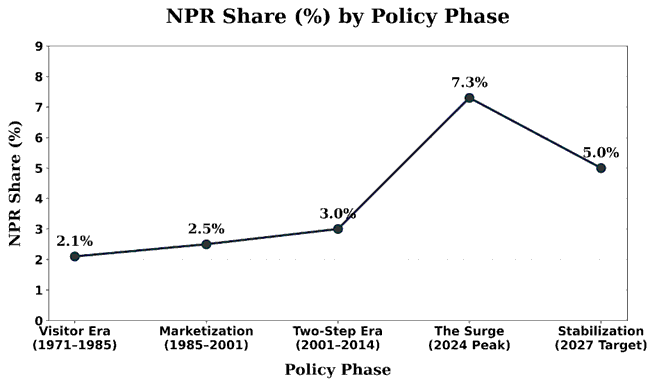
Source: Author’s synthesis of Statistics Canada Table 17-10-0121-01 and PBO (2024) projections
Figure 1. NPR Share (%) of Total Population by Policy Phase (1971–2027)This statistical snapshot presented in Table 2 confirms that the South Korean student body is one of the most stable and balanced in the Canadian system (Anderson, 2020). While other major source nations exhibit heavily male-dominated migration patterns—often linked to specific sectoral labor demands—the South Korean cohort provides a demographic corrective that aligns with Canada’s broader social equity and integration goals (Oduwaye et al., 2023). This gender parity suggests that South Korean migration is driven more by long-term human capital investment and family-based exit strategies than by immediate, short-term economic returns (Anderson, 2020).
| Country | Total University Students | Male Ratio (%) | Female Ratio (%) |
| China | 53,634 | 47% | 53% |
| India | 9,042 | 70% | 30% |
| Saudi Arabia | 6,210 | 75% | 25% |
| South Korea | 3,582 | 49% | 51% |
| Pakistan | 2,397 | 80% | 20% |
Integration Challenges: A 21-year Trend Analysis
Despite their high levels of human capital, South Korean NPRs face systemic integration challenges that have remained stagnant for over two decades. Research spanning 2002 to 2023 indicates that the Canadian Dream is often marred by three critical issues (Oduwaye et al., 2023).
Language remains a primary root cause of academic and social stress. However, scholars have identified a shift from simple language barriers to the more insidious linguistic racism (Oduwaye et al., 2023). This occurs when students are discriminated against not because of a lack of proficiency, but because of their foreign accents or ethnic stereotyping. For South Korean students, who often invest thousands of dollars in Haggwon (private academy) English training before arrival, the realization that an accent still functions as a barrier to high-level employment is a source of profound status frustration (Anderson, 2020).
The political economy of Canadian higher education relies on the fact that international students pay tuition that is triple or quadruple the domestic rate. This has led to the Cash Cow metaphor, where students are viewed by institutions as revenue streams rather than community members (McCartney, 2021). For South Korean families, particularly during periods of Won-Dollar exchange rate volatility, this creates immense financial pressure. The Wild Goose Father (Girogi Appa) phenomenon—where the father stays in Korea to earn money while the mother and children live in Canada—is a direct result of this high-cost educational model and the resulting economic precarity (Anderson, 2020).
The psychological impact of temporary status is acute. The uncertainty of whether a permit will be renewed or if a permanent residency (PR) application will be successful creates a state of permanent temporariness (Oduwaye et al., 2023). Furthermore, cultural stigmas surrounding mental health in East Asian societies often prevent South Korean students from utilizing university counseling services until they reach a crisis point (Anderson, 2020). This isolation is exacerbated by the loss of traditional Korean social networks (In-maek) and the challenge of building new ones in a hyper-individualistic Western society.
Future Outlook: Policy Stabilization and Integrity (2025–2027)
In response to the critical turn in public opinion regarding housing and infrastructure, the Canadian government has initiated a Stabilization Phase (IRCC, 2024). This marks the end of the era of unfettered NPR growth and a return to more regulated demographic management.
1. The 5% Target: The federal goal is to reduce the NPR share of the total population from its peak of over 7.3% to a sustainable 5% by the end of 2026 (Parliamentary Budget Officer, 2024; IRCC, 2024). For South Korean applicants, this signifies that the era of nearly automatic permit approvals has concluded.
2. Study Permit Caps: The 2025 cap of 305,900 new study permits represents a massive reduction from 2023 levels of 1,040,985 permit holders in Canada (IRCC, 2024). However, the government has indicated it will prioritize degree-granting universities over private career colleges. This policy shift actually favors the traditional South Korean student profile, which leans toward university-level education, over the high-volume vocational student profile common in other cohorts (Anderson, 2020; McCartney, 2021).
3. Sector-Specific Prioritization: The future of work permits will be tied to labor market integrity. The International Mobility Program (IMP) and Express Entry will now focus heavily on Healthcare, STEM, and the Skilled Trades (IRCC, 2024). For South Korean youth, the advice is clear: a general business degree is no longer a guaranteed ticket to PR; technical specialization is the new requirement (Crossman et al., 2022).
4. In-Canada Focus for PR: In 2025, over 40% of all permanent resident admissions are expected to come from individuals already living in Canada as students or workers (IRCC, 2024). This in-land preference rewards those who have already integrated into the labor market and society, providing a silver lining for the South Koreans currently in the system (Crossman et al., 2022).
Conclusion: Toward a Quality-over-Quantity Framework
The evolution of Canada’s relationship with international students and temporary workers has been one of the most significant sociological shifts in the nation's history. As documented by McCartney (2021), policy has moved from an era of charity and aid in the 1970s, through a period of marketization and self-interest in the 1990s, to what is now a high-stakes economic partnership characterized by the two-step immigration model (Crossman et al., 2022).
South Korean students and workers occupy a unique and vital niche in this landscape. As a cohort, they represent the ideal demographic that the Canadian state claims to prioritize: they exhibit exceptional gender balance, high levels of prior human capital, and strong potential for cultural integration (Anderson, 2020). However, they remain a group uniquely vulnerable to the cash cow institutional mentality and the persistent barriers of linguistic racism that have marred the international student experience for over two decades (Oduwaye et al., 2023).
As the Canadian state pivots toward its 5% stabilization target for the non-permanent resident population, the competition for the remaining spots in the immigration stream will be fierce (Parliamentary Budget Officer, 2024). Success in this new landscape will require a fundamental shift in strategy. Canadian institutions must move beyond viewing South Korean students as mere revenue sources and begin treating them as prospective citizens who require holistic support to thrive (McCartney, 2021). For the South Korean diaspora, the future lies in aligning their high human capital with Canada's newly prioritized labor gaps in healthcare, technology, and the skilled trades (Immigration, Refugees and Citizenship Canada [IRCC], 2024).
The quality over quantity approach, necessitated by systemic pressures on housing and municipal infrastructure, represents more than just a policy change; it is a moral imperative (Parliamentary Budget Officer, 2024). If Canada is to remain a premier destination for the best and brightest from Seoul to Busan, it must prove that the Two-Step Immigration model is not merely a revenue trap for cash-strapped institutions, but a genuine and equitable pathway to a shared and prosperous future (Crossman et al., 2022).
REFERENCES
1.
https://www.researchgate.net/publication/342219355_International_and_Refugee_University_Students_in_Canada_Trends_Barriers_and_the_Future#read

2.
https://www.mcgill.ca/misc/files/misc/misc_canadian_exceptionalism_2017_final_report_-04-18-2017.pdf
3.
https://www150.statcan.gc.ca/n1/pub/36-28-0001/2022003/article/00001-eng.pdf
4.
https://www.canada.ca/en/immigration-refugees-citizenship/corporate/publications-manuals/annual-report-parliament-immigration-2024.html
5.
https://www.erudit.org/en/journals/cjhe/2021-v51-n3-cjhe06684/1085333ar.pdf
6.
https://www.researchgate.net/publication/376260354_A_Trend_Analysis_of_the_Challenges_of_International_Students_Over_21_Years
7.
https://www.pbo-dpb.ca/en/publications/RP-2425-021-S
8.
https://www150.statcan.gc.ca/n1/daily-quotidien/221026/dq221026a-eng.htm
9.
https://doi.org/10.25318/1710012101-eng
10.
https://www150.statcan.gc.ca/n1/en/catalogue/11-633-X2025004