Social and Cultural Integration of Internationally Trained Immigrants in Northern Ontario, Canada
Received: 2025-10-10 ; Accepted: 2025-11-30
Published Online: 2025-12-31
Abstract
We investigated the challenges faced by internationally trained immigrants’ (ITIs) social and cultural integration in Northern Ontario, Canada. In-depth face-to-face interviews were conducted with 74 ITIs, immigrated to Canada within the past 10 years and living in a Northern Ontario community for a minimum of six months. Results show their eexpectation prior to arrival in Canada were overly optimistic, based on word-of-mouth referrals from friends, family, and former immigrants but underestimated the requirement for Canadian credentials and lacked preparedness for social integration, language skills, cultural awareness and networks. Perceptions reported include greater access to transportation, language training, employment and settlement services for newcomers was required in Northern Ontario as compared to larger cities. Participants felt they were better able to integrate when they prepared from their home country, attended a Canadian educational institution, or had a network of family and friends for support. Findings have policy relevance at the federal, provincial and community level and may be extended to other Canadian cities
본문
INTRODUCTION
Immigrants have been coming to Canada for centuries, however, the majority of new immigrants now tend to settle in Montreal, Toronto, and Vancouver (MTV), as opposed to smaller communities, citing the attraction and support available from an already established immigrant community (McQuillan, 2024). Job prospects, family reunification, standard of living, and escaping political or economic conditions are just a few of the reasons for immigration to Canada that have been examined (Alfred, 2002). Several studies have explored the reasons why newcomers arrive and settle in Ontario (Esses et al., 2021), and in particular, choose the City of Toronto (Preston et al., 2022; Triadafilopoulos, 2021). Family reunification, better employment prospects, desire for improved quality of life, better educational opportunities are just a few of the reasons for immigration to Canada that have been researched (Esses et al., 2021; Zhang et al., 2023; Schinnerl & Ellermann, 2023; Statistics Canada, 2022). Some researchers argue that the choice of settlement area has very little to do with services offered and more to do with family and kin residing in a given area (Picot & Sweetman, 2012).
Settlement choices are influenced by the many challenges faced by immigrants in the process of establishing themselves in the new country. Several of these challenges, have been outlined in the literature for the case of Southern Ontario, (Picot & Sweetman, 2012). The more prevalent of these barriers is access to settlement services (Mukhtar et al., 2015). Better clusters of services are available in Montreal, Toronto and Vancouver (MTV). Transportation access issues are recognized as another barrier as many newly arrived immigrant women do not have driver’s licenses or access to cars and larger cities are better equipped to offer a breath of transportation services (Susanna, 2024).
Consequently, small cities and communities appear to be excluded as attractive settlement areas for new immigrants. This pattern has been changing in the recent years with more newcomers settling in smaller urban or rural areas (McQuillan, 2024). Hence, there is a need to understand the rationale behind this shift, in order to better address the needs for services of these newcomers. While it relates back to the reasons for arrival in Canada, this point is important when discussing settlement barriers because it is shown that even a small established community of immigrants can act as a draw for further settlement, which has the potential ability to refocus services to new areas as immigration shifts to cities outside of these three major hubs, the services will have to relocate accordingly (Picot & Sweetman, 2012). In addition, the services to aid in settlement and promote integration among newly arrived immigrants are significantly strained in larger cities where immigration numbers tend to be higher. If the settlement patterns can be dispersed to smaller communities, with reliable service availability, access, and delivery, then there is the potential to alleviate the immigration related pressures on urban areas.
Unfortunately, there have been very few studies that explored the nature of immigration and the settlement barriers to immigrants arriving in Northern Ontario. The only studies we have found was a report by Chris Southcott (2007) that found that Northern Ontario tends to attract few immigrants and a study by Yantha (2020), which examines the challenges and prospects of an immigration pilot project in Northern Ontario. Furthermore, a study by Kelly and Nguyen (2023) explores non-metropolitan cities in Ontario and explains why immigrants choose to remain in smaller centers including the ones in Northern Ontario. However, most of the newcomers were students and/or contract workers on temporary visas rather than immigrants.
Much focus is being placed on the role immigration plays in the Ontario labour landscape. It has been estimated that net migration to the province of Ontario will account for 68 percent of all population growth in the next 25 years (Ministry of Finance, 2011). Labour force dynamics in the province of Ontario and especially in the north is affected by baby boom exits, significant changes in the production levels of Ontario’s main industries, emigration to economically booming provinces, trade relationships with the US, and more general global economic forces.
Future workforce growth is expected to come from immigrating professionals to Canada (Reitz, 2005, p. 413), yet Northern Ontario has experienced ongoing out-migration of skilled workers. The 2012 Canadian Federal Budget, “Jobs, Growth, and Long-Term Prosperity” (Ministry of Finance, 2012) and the 2012 Ontario Budget, “Strong Action for Ontario” (Ministry of Finance, 2012) both refer to the North’s natural resources and its ability to create jobs and attract skilled immigrants valued by Canadian employers. The five major cities in Northern Ontario are now collaborating under ‘One North’ to develop an economic development and immigration attraction strategy recognizing that they must act now.
Canada's official multiculturalism policy promotes both cultural diversity and equitable participation in society (Kymlicka, 2010). However, despite this welcoming policy framework, internationally trained immigrants face persistent integration challenges, particularly in credential recognition and labor market access (Reitz & Banerjee, 2007). These challenges may be amplified in Northern Ontario due to geographic isolation and limited settlement services.
This study constitutes the second component of a broader research project examining the economic and social integration of internationally trained immigrants, undertaken through the Professions North/Nord initiative in Northern Ontario (Robichaud et al., 2022). In this study, we analyze the settlement of immigrants aimed at identifying the main socio-cultural barriers to the integration of new immigrants in Northern Ontario communities. Our main motivation in conducting this research is to bridge the gap in the existing literature, regarding the settlement of immigrants in Northern Ontario. The objectives are to profile the type of the newcomers, the reasons why they make this choice, and the challenges they face in Northern Ontario communities. Our paper is organized as follows: section 2, reviews the literature on the socio-cultural dimensions of immigration in Canada; followed by methodology in section 3; results and analysis in section 4; finally, discussion, recommendations, and conclusions in section 5.
Literature Review
The body of literature regarding immigrant integration in Canada is vast and varied in education (Lo et al., 2001; Reitz 2001; Walton-Roberts, 2011), employment (Robichaud et al., 2022; Lo et al., 2001; Owen & Lo, 2008; Orme 2007; Picot & Sweetman, 2012; Reitz, 2001; Truelove, 2000; Walters et al., 2006), integration services (Albert et al., 2012; Picot & Sweetman, 2012; Reitz, 2001; Truelove, 2000), and social integration processes (Entzinger & Biezeveld, 2003; Li, 2003; Reitz 2007). These different factors affect the arrival experience of immigrants, their socio-cultural and economic integration experiences, that can alter outcomes.
Broad reasons why immigrants choose to immigrate generally, such as, better employment prospects, desire for improved quality of life, better educational opportunities (Esses et al., 2021; Zhang et al., 2023; Schinnerl & Ellermann, 2023; Statistics Canada, 2022) and why newcomers arrive in Ontario is no surprise given the city of Toronto receives one of the highest amounts of immigrants than any other city in Canada (Esses et al., 2021; Preston et al. 2022; Triadafilopoulos, 2021).
Literature specific to reasons newcomers chose to immigrate to Northern Ontario is sparse. The Association of Municipalities of Ontario (AMO) does not specifically divulge any information pertaining to why immigrants would choose Northern Ontario over other parts of the province as their settlement choice, but does point out that:
The AMO article provides a case study on efforts undertaken by North Bay to attract immigration to Northern Ontario (AMO, 2008). The strategy was successful and received funding from Citizenship and Immigration Canada for a multicultural centre in the city and could be useful in developing immigration attraction strategies to promote settlement in other cities Northern Ontario to showcase that peace and low crime rates are reasons some newcomers choose specific cities to settle in. This factor must be examined before policy options can be put forward to make the area more attractive to newcomers, where possible.
There is research on the issues immigrants encounter once they have arrived in Canada, and even Ontario, but is void on the issues specific to immigrants arriving in Northern Ontario. The available literature suggests that recent immigrants to Canada are having an increasingly difficult time finding jobs that suit their educational and employment profiles (Alboim, Finnie & Meng 2005; Owen & Lo 2008; Preston et al. 2007).
It is important to point out that Canada has a long history of immigrants arriving over the centuries and Canadians pride themselves as living in a country that has always been welcoming of immigrants from all over the world and settling here in a strongly supportive multicultural environment that encourages the maintenance of traditional cultural ways within the Canadian multicultural social fabric. Research shows that the term or category of social integration is being widely used, as well as the role that family social networks play in influencing labor market entry in Canada's unique characteristic as a welcoming multicultural country. The concepts of social integration, exclusion and family support as well as family social networks influence labor market entry opportunities. Our study is within Canada's official multiculturalism policy framework (Kymlicka, 2010) while noting the documented gap between policy ideals and immigrants' lived experiences, particularly in smaller communities (Reitz & Banerjee, 2007).
In conceptualizing social integration, we draw on Berry's (1997) acculturation framework, which defines social integration as a process wherein immigrants maintain their cultural identity while actively participating in the broader society. This bidirectional process involves both newcomers adapting to their host society and the receiving community accommodating diversity. For our study, social integration encompasses: (1) participation in labor markets and civic life, (2) development of social networks beyond one's ethnic community, and (3) access to services and resources available to all residents.
Family and ethnic social networks play a complex role in labor market integration. While bonding capital (strong ties within one's ethnic group) provides initial support and information, bridging capital (connections across diverse groups) is often more valuable for accessing employment opportunities (Ryan et al., 2008; Nangia, 2013). Our findings reveal this duality: family networks provided crucial settlement support but sometimes transmitted overly optimistic or outdated information about Canadian labor market requirements.
This study is situated within Canada's official multiculturalism policy framework, established in 1971 and enshrined in the 1988 Multiculturalism Act (Kymlicka, 2010). While this policy promotes cultural diversity and equal participation, scholars note persistent gaps between multicultural ideals and immigrants' lived experiences, particularly regarding credential recognition and labor market integration (Reitz & Banerjee, 2007). Northern Ontario's geographic and demographic context may amplify these challenges.
Most of the literature focuses on the settlement barriers that immigrants typically experience when first arriving in Canada. Some articles explore the socio-cultural and economic barriers to settlement in specific cities in southern Ontario (Orme, 2007; Picot & Sweetman 2012; Truelove, 2000) but settlement barriers to immigrants arriving in Northern Ontario remain a data gap. Since Toronto, Vancouver, and Montreal are typically the cities that newly arrived immigrants arrive in, most settlement services tend to cluster in these areas. As this trend shifts to cities outside of these three major hubs, the services will have to relocate accordingly (Picot & Sweetman, 2012). This is particularly applicable to Northern Ontario since the transit systems are not as multi-modal or frequent as they are in the southern part of the province, potentially creating a bigger barrier for immigrants attempting to access settlement services.
The literature is also able to point out that the choice of settlement area has very little to do with services offered, and more to do with family and kin residing in a given area (Picot & Sweetman, 2012). While this relates back to reasons for arrival, this point is important when discussing settlement barriers because it is shown that even a small established community of immigrants can act as a draw for further settlement, which has the potential ability to refocus services to new areas (Picot & Sweetman, 2012). Moreover, the services to aid in settlement and promote integration among newly arrived immigrants are significantly strained in bigger cities where immigration numbers tend to be higher. If the settlement patterns can be dispersed, and service delivery maintained in smaller communities, then the services available have the potential to be more substantive in the event of alleviated strain.
Responding to changing settlement patterns and attracting immigrants to settle in certain communities is also discussed in the literature. As example, Burr (2011) discusses the Local Integration Partnerships (LIP) initiative undertaken by various communities in Ontario and the importance of programs such as this in attracting and integrating newcomers. LIPs are a multistakeholder collaboration which enables communities to “develop strategic plans to address the opportunities and challenges associated with fostering inclusive and responsive environments” (Burr, 2011, p. 1). The literature available on LIPs demonstrates that communities in Ontario are recognizing the need to invigorate the attraction and settlement strategies for newcomers in Ontario, and placing an emphasis on the important of this occurring from the ground up and as partnerships with different levels of government.
Although AMO provided a case study on the efforts expanded by the city of North Bay to attract immigration to Northern Ontario (AMO, 2008) it does not conclusively determine reasons for immigrants arriving in Northern Ontario. Without information on the factors that attract immigrants to Northern Ontario, any effort to increase immigration may be difficult. A notable gap exists in the literature on the specific reasons why newcomers choose to immigrate to regions such as Northern Ontario so that clearer policy options can be considered to make Northern Ontario more attractive to newcomers.
Methodology and Research Questions
This study focused on immigrants in the five main communities in Northern Ontario: Sudbury, Thunder Bay, North Bay, Sault Ste. Marie, and Timmins. We collected data from 74 respondents: 27 from Sudbury, 12 from North Bay, 10 from Timmins, 10 from Thunder Bay, and 15 from Sault Ste Marie. Interviews were conducted over a two year period from the summer of 2011 to 2013. This timeframe allowed us to recruit participants across different seasons, capturing experiences during both summer and winter months?an important consideration given Northern Ontario's climate challenges that participants frequently mentioned as affecting their integration. Following Berry (1997), we conceptualized social integration as encompassing labor market participation, social network formation, and access to settlement services.
In-depth, face-to-face interviews were selected as the primary data collection method for several reasons (Creswell & Poth, 2018; Rubin & Rubin, 2012). First, our research objective was exploratory?to understand the lived experiences and subjective perspectives of ITIs in Northern Ontario, a population and context underrepresented in existing literature. Interviews allow participants to articulate complex narratives about their integration journey in their own words (DiCicco-Bloom & Crabtree, 2006). Second, face-to-face interviews enabled rapport-building and cultural sensitivity, particularly important given participants' diverse linguistic and cultural backgrounds. Third, this method allowed flexibility to probe emerging themes and clarify participants' meanings, yielding richer data than structured surveys could provide. The conversational nature of interviews was especially appropriate for exploring sensitive topics such as unmet expectations and experiences of discrimination.
The integration barriers examined in this study emerged inductively from our data analysis rather than being predetermined. Following grounded theory principles (Charmaz, 2014), we conducted iterative thematic analysis of interview transcripts to identify recurring challenges participants reported. Initial open coding revealed patterns across multiple domains: credential recognition, language proficiency, social network development, and access to settlement services. These themes were refined through constant comparison across interviews and consultation with community stakeholders. This inductive approach allowed us to capture barriers most salient to ITIs' lived experiences in Northern Ontario rather than imposing a priori categories that might not reflect regional realities.
Table 1 below provides various characteristics of the sample. It features 60% of male immigrants and 40 % female immigrants. The average age of the participants is 35.1 years with 46 % of the respondents being in the 31 to 40 years category. Over 76% of the sample spoke at least one of the two official languages of Canada: English (69%) and French (7%). The participants had different geographical backgrounds, with 36% coming from Asia, 34% from Africa, 4% from North America, 4% from Europe, 3% from South America, 1% from Oceania and 18% are unknown. In addition, 60% of the research participants were classified as independent professionals and 23 percent were family sponsored. In term of current Canadian work status, 18% were employed in the same occupation as in the country of origin, 42% were employed in a different occupation from the one in the country of origin and 36% were unemployed. Finally, 5% had a high school degree and 95% have a postsecondary education. The education was obtained internationally for 51% of the sample, and in Canada for 33%.
| Frequency | Percentage | |
|
Gender: Male Female | 44 30 | 60 40 |
|
Age 20-30 years 31-40 years 41-60 years Blank | 21 34 17 2 | 28 46 23 3 |
|
Principal Language Official Language of Canada Non Official Language of Canada Blank | 56 16 2 | 76 22 2 |
|
Ethnicity Asia Africa North America Europe South America Oceania Unknown | 27 25 3 3 2 1 13 | 36 34 4 4 3 1 18 |
|
Immigration Class Independent Profession/skilled trades Family Sponsored Convention Refugee Provincial Nominee Canadian Experience Independent Business Other | 44 17 2 2 1 1 7 | 60 23 3 3 1 1 9 |
|
Current Canadian Work Status Employed in the Same Occupation as Country of Origin Employed in Different Occupation as Country or Origin Unemployed Blank | 13 31 27 3 | 18 42 36 4 |
|
Highest Education High School College University (Bachelor, Master or Doctorate) | 4 11 59 | 5 15 80 |
|
Country of Education Canada International Unknown | 24 38 12 | 33 51 16 |
We used paper questionnaires and ethnographic techniques using open ended interviews (Appendix A) to profile immigrants settled in Northern Ontario, specifically exploring the following research questions about this population:
- Their initial expectations while arriving to Canada and Northern Ontario as well as their on-going experiences;
- Their reasons for settling in Northern Ontario and their particular community;
- Their social integration process within their adopted community and any possible problems encountered;
- The challenges they have overcome and the perceived challenges that are still ahead; and finally,
- The likelihood of them remaining in Northern Ontario and what they believe could be done in the future to retain other immigrants in their community.
Statistics Canada Labour Force Survey defines very recent immigrants as landed immigrants for less than 5 years, recent immigrants as landed immigrants for between 5 to 10 years and established immigrants as landed immigrants for over 10 years. For the purpose of this study an immigrant is a very recent or a recent landed immigrants who has been living in a Northern Ontario community for a minimum of six months. To recruit participants for the study, we targeted multicultural, newcomer, and settlement organisations as well as other agencies that frequently deal with immigrants in each of the five communities including PNN, a pan-northern Ontario bridging for internationally trained professionals.
Data were collected through in-person face-to-face in-depth one-hour interviews with various participants in each of the five communities. The interviews took place on the premises of the multicultural/settlement organisation in the participant’s community in a private office/board room. Each theme-related question was asked in a pre-determined order. All interviews were audio recorded with the consent of the participants and then transcribed.
In addition to the interview, each participant filled out a paper questionnaire in order to gather more in-depth information. This questionnaire was used to determine the following topics; demographics (ethnic group, age, gender, principal language of communication), status in Canada (immigration status, immigration class, arrival in Canada alone or with family), education (highest level of education, field of study, country), career (main occupation in country of origin, main occupation in Canada, current work status in Canada) and community services and resources used in Canada. The gathered information allowed for a more complete analysis of the situation.
Once the interviews were done, a transcript was made based on the recordings of the dialogues. In order to properly analyze the information, an evaluation grid was created to identify the key points. Each transcript was then summarized into a new document, thus bringing out the relevant information based on each theme. Once the relevant information was compiled into the evaluation grid, an analysis of the pertinent information was made.
Results and Analysis
An analysis of the initial expectations for coming to Canada and Northern Ontario shows that some people made some research before coming to Canada (89%) and other people not (11%). The expectations observed are classified and presented in Table 2. These expectations were similar, regardless of the Northern Ontario city where the respondent was living in.
Immigrants, who came to Canada to join family or friends, because of its quality of life, or for other reasons, generally faced greater challenges in their social integration. Expectations prior to arrival were often overly optimistic, and based on word-of-mouth referrals from friends, family, and other immigrants. These individuals tended to underestimate the requirement for Canadian credentials and lacked preparedness for social networking, such as cultural awareness. For example, a young woman from India who immigrated to Canada in 2004 described her expectations as follows:
“...[my initial expectations were] like money is growing on trees in Canada and you think ‘oh my god’ we are just going there and grabbing it but when I come to Canada it was kind of a shock for me like no, it’s not. You have to work really hard to get what you want but if you have potential then you can grab it.” [Respondent # 2]
| Frequency | Percentage | |
| Expected that it is easy to get a job | 24 | 16 |
| Expected cold weather | 21 | 14 |
| Expected to have better education | 17 | 11 |
| Expected to have a better life | 16 | 11 |
| Expected tough integration and challenges | 13 | 9 |
| Expected a developed economy (big cities) | 9 | 6 |
| Expected difficulties getting employment | 9 | 6 |
| Expected safe environment | 8 | 5 |
| Expected friendly people | 8 | 5 |
| Expected a peaceful environment | 6 | 4 |
| Expected to integrate into a liberal environment | 3 | 2 |
| No research before coming and Other | 16 | 11 |
Overall, 50% of the respondents indicated that they came to Northern Ontario for jobs, 38% for education, and 12% for family reasons, as illustrated in Figure 1. However, the situation in each of the five communities in more contrasted. Immigrants in Timmins in their large majority (90%) moved there for employment reasons. Employment is the major reason for settlement in North Bay and Sault St Marie. However, in Thunder Bay and Sudbury, education as the main reason for coming to Northern Ontario, at 60% and 56% respectively. This of course is consistent with the fact that Northern Ontario postsecondary institutions are mainly located in the two cities.
The reasons given by the respondents for coming to Northern Ontario are similar to the reasons for coming to Canada studied in other works (Alfred, 2002; Clark, Hatton and Williamson, 2002; Portsmouth, 2002) and can be grouped into 5 categories: work opportunities (19%), education or skills-training (18%), to join family or friends (35%), quality of life (5%) and other (15%).
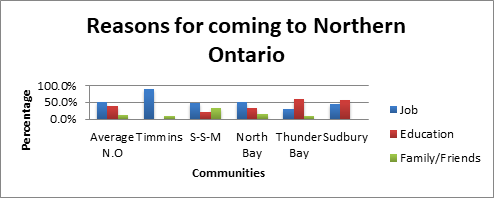
There is a difference between immigrants who came directly to Northern Ontario upon immigrations and those who came after. From the 74 respondents, 38% came directly to Northern Ontario and 62% came to Northern Ontario a few months to a few years after immigrating to Canada. For those who came directly to Northern Ontario, their principal reasons were for family, education, or got a job before immigrating. The immigrants who move to Northern Ontario, after some time elsewhere in Canada, did it mainly to mainly pursue their education or because they managed to get a job or an opportunity in Northern Ontario.
The following testimony shows that family played a big part in the reasons for immigrants coming directly to Northern Ontario. This individual came directly to North Bay from Kenya.
This individual demonstrates that the only reason that he came to Northern Ontario was to re-educate himself in order to improve his chances of getting opportunities.
Other respondents came to Northern Ontario because of employment opportunities. As example, this individual stated that employment was a priority.
The social and cultural networks are described as the different organizations that were used to help integrate immigrants into society. Figure 2 illustrates the social and cultural networks accessed by our sample.
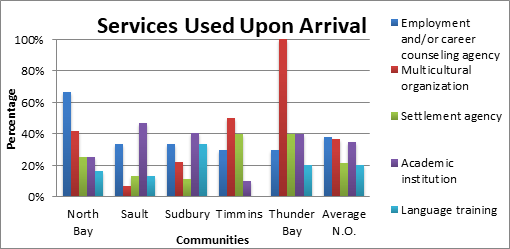
The main organizations used were: employment services, accessed by 38% of the participants; multicultural association services, accessed by 36%; academic institutions, accessed by 35%; settlement services accessed by 22% and language training by 20%. Note that none of the immigrants in Timmins used a language training service, while all the immigrants who went to Thunder Bay used the Multicultural Organization services.
With over 78% of surveyed immigrants knowing one of the 2 official languages of Canada and 20% using language training, the language was not perceived to be a barrier to integration. The majority of immigrants indicated that they know they have an accent but they manage to adapt to the Canadian language, which indicated that language is not a problem. As an example, most immigrants who had language barriers to employment were able to overcome their barriers with the help of language training centres, universities, and other language resources. The language barrier was manageable, and once a minimum standard for employment was achieved, the individuals were able to continue to develop their English and French language skills in a professional setting, on the job. A Japanese woman recounts arriving in Northern Ontario in 2007 with no prior English language training and using a settlement agency to find English-as-a-Second-Language (“ESL”) classes to facilitate her social and economic integration:
The successes of immigrants who seek language training can be seen in other conversations with immigrants facing language barriers. These findings correspond to the findings identified in the literature review placing an emphasis on settlement services as an aid to integration (Lo et al., 2000). Some authors (Hiebert, 2009; Lo et al., 2000; Omidvar 7 Richmond, 2003) examining issues such as social integration, propose that the only real solution is an increase in availability and the assurance of access to employment and settlement services for newcomers. Participants in our study clearly indicated that they had an easier time integrating once these services were obtained:
Some survey participants discussed difficulties due to a deficiency in language, particularly during the job application process. Effort in understanding job requirements, difficulty communicating during the interview process, and difficulty socializing on the job have been cited as challenges for new immigrants whose principal language is not one of Canada’s official languages. These results are not surprising considering that 22% of the participating group did not list English or French as one of their principal languages (Table 2). While language as a barrier was not teased out in the literature review as a subtopic, the idea that the immigration system, and specifically the immigrant selection criteria as a whole was examined. In order to guarantee immigrants full participation and integration into the workforce, the selection criteria must ensure candidates are able to speak one of the official languages to find a job; the results of this survey clearly demonstrate an issue with immigration policy as a whole. In addition to a language barrier, there seems to be a lack of confidence with respect to language and communication that is proving to be a barrier to employment. One recent Chinese immigrant describes his perception of his employability based on his limited proficiency with the English language:
It is evident that language skills are required by employers and some new immigrants are citing language as a barrier to employment. A young Swahili-speaking man from Kenya, immigrated to Northern Ontario with a college diploma in accounting and foreign work experience as an accountant. He applied for several jobs without receiving an interview, and was encouraged to place a follow up phone call to employers. During the conversation with employers, the applicant found it challenging to communicate due to a strong language barrier:
The applicant is now in the process of obtaining Canadian education, and working on his language skills to be more job-ready. Overall, skilled immigrants have found that in a competitive job market, communication skills can be a deciding factor for employees, when all else is equal:
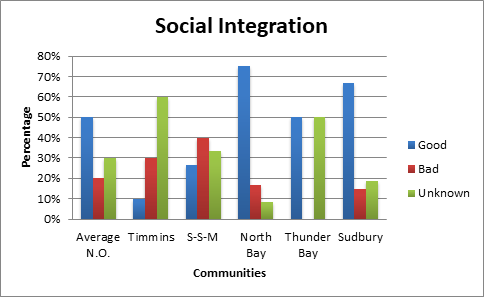
Taking an average of all five communities in Northern Ontario, 50 percent had a good integration into society, 20 percent had a bad integration into society, and 30 percent are considered as unknown. The people classified in the unknown category are either unsure themselves of their social integration or have given mixed signals as far as their integration (some good things and some bad things). This indicates that the immigrants are split on the question of social integration; some of them have had difficulties integrating socially into Northern Ontario while others have not.
Based on the results from the different communities in Northern Ontario, two of them stand out. Timmins and Sault-St. Marie are the two cities with the worst level of integration into society. 30 percent of the immigrants in Timmins indicated that they have had a bad integration into society while 40 percent of the immigrants in Sault-St. Marie indicated the same trend. These are the exceptions to Northern Ontario as the other communities have a much higher satisfaction rate.
Some of the survey participants that described Northern Ontario communities as unwelcoming to newcomers and resistant to change identified networking as a key source of employment opportunities in Northern Ontario. Breaking in to the social circle is the first step towards social integration, and it appears that social integration is a very important step towards economic participation. A young male from St. Lucia, describes his experience in Northern Ontario as trying to join a new family.
A young Chinese man, who has been living in Northern Ontario for 3 years, describes a job market dominated by personal referrals:
He goes on to compare his experiences in Northern Ontario to Toronto:
The problem seemed to be present in all of the surveyed communities. A young man from Ethiopia describes his challenges finding work in Northern Ontario without having entered the personal networks of friends here:
Immigrants who had success breaking into the social circles in Northern Ontario often had a champion; either a friend, colleague, or family member. A young Caucasian, English-speaking female from New Zealand moved to Northern Ontario with her husband, and found employment as a contract Geologist. Despite coming from a similar culture, and having full-time employment, she found it took a long time to make friends in the community:
Her husband also faced barriers to social and economic integration:
The lack of diversity in Northern Ontario communities was also noted:
Immigrants have fewer preferences in terms of where they are staying and are more concerned about getting better jobs. Only 26 percent have indicated that they will stay in Northern Ontario, 23 percent are definitively not staying, and 51 percent were unsure. The community with the highest percentage of immigrants leaving is once again Sault-St. Marie (40%) while the community with the highest percentage of immigrants staying is Sudbury (66.67%). These statistics along with the statistics from the social integration into society indicate that the community of Sault-St. Marie is not favourable for immigrants. There are a lot of bad experiences coming from this area of Northern Ontario, which pushes immigrants to leave and pursue other opportunities.
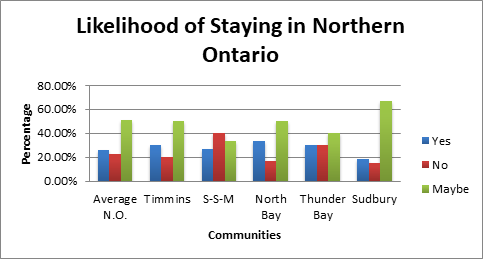
The reasons given by respondents for either leaving or staying in Northern Ontario are the following: jobs (79%), education (3%), family (8%) and other reasons (10%). The other category could mean a variety of things like: there aren’t enough cultural services or food, not well integrated into society, etc. Every community has a high percentage (over 60%) for employment as a reason for leaving or staying in Northern Ontario. The majority of people who were classified in the “maybe” category had like main reason of jobs as well. Their decisions for leaving or staying will be strictly made on their employment status.
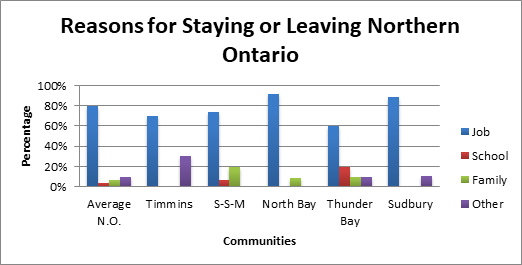
Immigrants have employment like main priority, and the community of city that they live in is less important. Many survey participants indicated that they would move wherever the jobs are, even if they do like Northern Ontario. Here are some testimonies:
Education is also another reason for immigrants leaving Northern Ontario. This particular individual is moving to a southern city with her family to pursue Teacher’s College. They will try to find employment in this southern area before looking for opportunities in other cities.
Discussion, Recommendations, and Conclusions
Northern Ontario faces particular challenges based on geography and population, as compared to Southern Ontario, with the large territory of the north coupled with a small population density and long distances between communities complicate providing access to certain services to the general public and especially to immigrants. In this respect, immigrants might not always be able to access the services that would help them to integrate and flourish in their northern community.
This study revealed several key themes about immigrant experiences in Northern Ontario that may differ from larger urban centres. Most newcomers in our sample had difficulty entering employment and socio-cultural networks in Northern Ontario without someone to facilitate the introduction. Newcomers reported feeling less supported and more alone in Northern Ontario communities, a feeling they alleged was less prevalent in larger centres. The lack of cultural food, services and ethnicity communities within the northern cities was also seen as an issue when it came to social integration into society. Respondents felt that Northern Ontario placed a larger emphasis on Canadian credentials and experience as compared to Southern Ontario. Survey respondents verbalized the discrepancy with socio-cultural and economic integration between Northern Ontario and Toronto, and some survey respondents reported their intent to relocate to Toronto or other locations due to the degree of foreign earned credential devaluation in Northern Ontario. In order to gain Canadian experience, some immigrants turned to volunteering, but opportunities are limited and hard to come by. The individuals that did volunteering upon arrival to Canada have, in majority, seen it pay off. On a positive note, those immigrants who arranged employment or education prior to arriving in Northern Ontario had the greatest success in social and economic integration and were most pleased with their decision to locate in Northern Ontario.
Our findings connect family networks explicitly to labor market opportunities, illuminating the dual nature of family social networks in labor market entry. Consistent with Ryan et al. (2008), bonding capital provided by family and co-ethnic networks facilitated initial settlement but did not always translate into employment success. Participants who relied solely on family networks for pre-arrival information developed unrealistic expectations about credential recognition and job prospects. Conversely, those who supplemented family support with bridging capital?through Canadian educational institutions or diverse professional networks?experienced smoother labor market transitions. This suggests that while family networks are crucial for social and emotional support, labor market integration in Northern Ontario requires deliberate cultivation of connections beyond one's immediate ethnic community.
In relation to the literature review, most of the findings of the Northern Ontario sample were similar to the findings of comparative works. As examples, immigrants who come to Northern Ontario for Canadian education tend to be better prepared to manage the integration process. Language was often cited as a barrier but one that immigrants could manage through language training courses offered at resource centres in the Northern Ontario cities. Canadian experience and education were significant barriers to entry into the workforce, causing immigrants to take ad-hoc low-paying jobs and volunteer positions. In some cases, work discrimination was encountered as immigrants indicated that their exotic name was a problem as employers automatically passed judgement. If the newcomers didn’t have support from contacts, getting employment was a big challenge in part caused by the closed mentality of employers and communities towards immigrants. Immigrants are looking for equal opportunities from the local employers. These are typical challenges defined in literature and in various cities and regions. A number of possible solutions can be devised at all levels of government and through various community interactions for a holistic approach to solving the challenge of improving socio-cultural and economic integration for newcomers. Although this survey does not provide an idealistic picture of the Northern Ontario experience, it may explain some of the decline in immigration over time and is a call for action to all stakeholders.
More recently, a poll showed that Canadian views on immigration are hardening blaming newcomers for increasing housing costs and calling on government to reduce annual immigration targets and increase deportations as there are about 500,000 undocumented immigrants living in Canada. Consequently, the federal government has responded with reductions in immigration targets going forward with 395,000 new permanent residents in 2025; 380,000 in 2026; and 365,000 in 2027; down from earlier targets of 500,000 newcomers per year. Of poll respondents, aware of the lowered immigration targets, 67 percent still said that was too many and of those not aware of lowered targets, 79 per cent said Canada was taking in too many people, while 61 percent said immigrants make important cultural contributions to Canada (Dawson, 2024).
In conclusion, labour migration is not only a Canadian issue but also relevant for other countries across the world that are struggling with a decreasing population base and labour shortages to sustain their economies. Consequently, as people move from one country to another to build a better life for themselves and their families many social, cultural, economic and political policy challenges will have to be addressed in order to integrate immigrants with different identities, education, language, skills and work experience. Discourse on the importance and intersectionality of identity, diversity, equality and inclusion will play a key role in achieving successful outcomes and experiences for everyone involved. While our focus was on the social integration challenges, we acknowledge that participants' experiences suggest the importance of exclusionary dimensions and family support. Thus, we note that these aspects warrant deeper investigation. Future research could explicitly examine exclusionary processes and the dual role of family networks using frameworks such as Ager and Strang (2008) and Guo and Guo (2016) to explore integration/exclusion and family support more deeply.
REFERENCES
1.

2.
3.
4.
5.
6.
7.
8.
9.
10.
11.
12.
13.
14.
15.
16.
17.
18.
19.
20.
21.
22.
23.
24.
25.
26.
27.
28.
29.
30.
31.
32.
33.
34.
35.
36.
37.
38.
39.
40.
41.
42.
43.
44.
45.
46.
47.
48.
49.
50.
51.
52.
53.
54.
55.
56.
APPENDIX
- Tell me a little bit about your decision to migrate to Canada.
- When and where did you arrive in Canada and what were your reasons for settling in Northern Ontario and in this particular community?
- Did you arrive alone or with your family?
- Did you have any prior contact with family/friends/support networks here?
- Could you briefly describe your initial expectations before you arrived in Canada (and Northern Ontario) and your ongoing experiences since your arrival?
- How was your personal and family social integration process within this new homeland (and community) and what were some of the opportunities and challenges you encountered?
- How was your job and economic outlook when you first arrived in this country (or city) as compared to what it is now?
- What were some of the socio-cultural challenges or difficulties that you had to face and how did you cope with them in terms of:
- Culture
- Language
- Social
- Work
- Family
- What is the likelihood of your remaining in Northern Ontario and what do you believe should be done to retain other immigrants in the community?
- If you had another chance, what would you change? Do you have any other comments that you would like to add